
Your Facelift Journey
Begins Here.
Welcome to Faceliftology. Your face and neck lift resource to help with your facial rejuvenation journey.
Welcome to Faceliftology, your trusted guide to understanding facial rejuvenation, modern facelift techniques, and the science behind aging gracefully. Whether you’re just beginning to explore your options or looking to deepen your knowledge, Faceliftology breaks down complex procedures into clear, approachable insights. From understanding the underlying causes of facial aging to comparing today’s most advanced surgical and nonsurgical facelift methods, our goal is to empower you with accurate, expert-level information to help you make confident, informed decisions about your aesthetic journey.
face·lift·ol·o·gy
noun
face·lift·ol·o·gy | \ ˌfās-lif-ˈtä-lə-jē \
1. The art and science of the facelift: the study of how the face ages in layers, how surgical technique is chosen and executed, and how those choices affect results, recovery, and risk.
2. often capitalized Faceliftology An independent educational platform devoted to that subject—written to cut through marketed procedure names and give patients clinically grounded information about facial rejuvenation.
What is a Facelift?
The medical term for a facelift is rhytidectomy, derived from the Greek “rhytis” meaning wrinkle, and “-ectomy,” meaning excision or removal. While the name literally suggests wrinkle removal, a facelift is not primarily a procedure to erase surface wrinkles. Instead, it is a surgical operation designed to lift and reposition sagging facial tissues, remove excess skin, and restore more rejuvenated contours to the face.
The primary goal of facelift surgery is to address the visible signs of facial aging such as gravitational descent of skin, fat, and deeper supportive structures (such as the SMAS layer). Contributing factors include aging, genetics, and sometimes significant weight loss. There are many variations of the procedure, ranging from limited-incision “mini” facelifts to more comprehensive SMAS or deep plane techniques. The appropriate approach depends on the patient’s anatomy, degree of tissue laxity, and individual cosmetic goals.
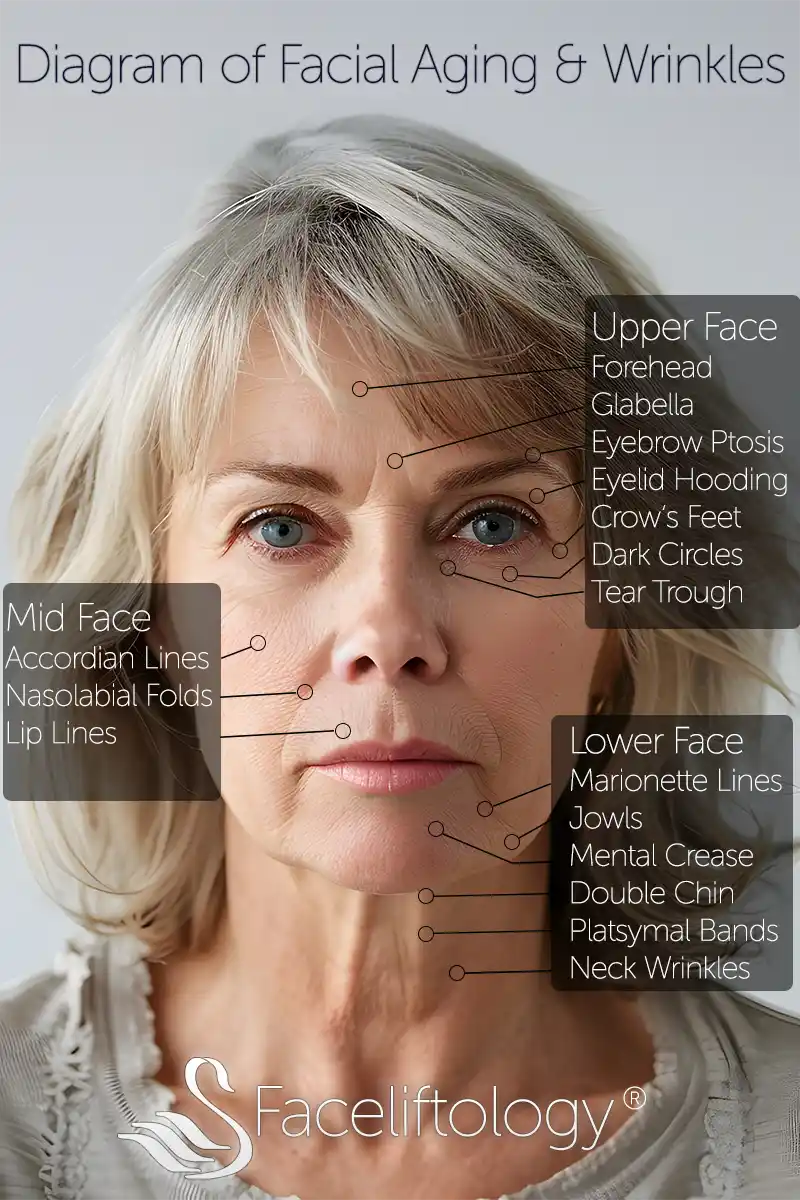
Facelift procedures focus on the area from the cheekbones (midface) downward to the jawline and often include the neck. The most common improvements target prominent nasolabial folds, jowls, and neck laxity.
Importantly, a facelift does not constitute total facial rejuvenation. It does not primarily address fine lines or wrinkles in the upper face (such as crow’s feet or forehead lines), skin texture or pigmentation issues, or significant volume loss. These concerns are typically better managed with complementary procedures such as eyelid surgery, brow lifting, skin resurfacing, or injectable treatments such as facial fat grafting.
Start with the part of the decision you are in
Once the definition is clear, the rest of Faceliftology is organized to help you understand the process.
Compare Facelift Techniques
Mini, SMAS, deep plane, and why the names keep multiplying.
Match a Technique to Your Face
A guide to help you decide which facelift is right for you.
Prepare for Surgery
What to do, what to buy, and how to get the face ready before the date.
Facelift Recovery
What to expect during facelift recovery in our comprehensive guide.
How do I know if I need a facelift?
Most patients ask this question when they first notice signs of aging that are beyond fine lines and minor facial wrinkles. Since everyone ages differently, establishing an exact age to have a facelift is not the usual factor to know if you need a facelift.
Most facelift surgeons help patients decide on facial rejuvenation by evaluating the patient’s current facial wrinkles and then recommend the appropriate cosmetic procedure. The specific depth of facial wrinkles helps establish if a facelift would be indicated to help you achieve your cosmetic goals.
If you have reached the point of performing the guilty “thumb lift” in the mirror to get an idea of what you might look like if that skin were tucked up, then you may be ready to begin the conversation if a facelift is right for you.
Local Anesthesia Facelifts: A Surgeon’s Perspective
A Discussion About Why I Changed to the Local Anesthesia Facelift After performing hundreds of facelifts under general anesthesia early in my career, I made a deliberate shift. For roughly the next fifteen years I performed well over 1,500 facelifts under local...

Are New Facelift Techniques Really Different?
Since the beginning of plastic surgery, surgeons have engaged in marketing tactics to set themselves apart from their competitors. The facelift procedure has been at the heart of marketing tactics to differentiate the surgeon’s artistic style, ease of recovery, and an...

Which facelift is right for you?
A Guide to Finding the Right Facelift for You When you start exploring facelift options, it’s natural to wonder which approach will give you the most natural, refreshed result. The answer isn’t about choosing the “best” facelift but about choosing the one that fits...